Wednesday, October 22, 2014

COLOR

Color Theory and Josef Albers

Color Theory is an intriguing aspect of art education because it is like chemistry, psychology and art all in one. 

Everyone seems to agree that music is capable of evoking emotional responses but some people underestimate the power of visual art, however in reality the two are quite similar. Both sound and light travel in waves. The biggest difference between sound waves and light waves is that light travels much faster. Sound waves stimulate sensors in our ears, while light waves stimulate sensors in our eyes. It is the variation in frequency of sound waves that creates music, just as it is the variation in frequency of the light waves that creates the different colors of the rainbow.


The Students will be painting color wheels that they will then learn how to use as an aid in choosing color schemes.

Sunday, September 28, 2014

The Elements of Art

Painting and drawing is an international language and has been around for at least 30,000 years. Like any language it is made up of parts, or elements. Written languages are made up of nouns, verbs, and adjectives, while drawings are made up of 7 elements referred to as "the elements of art": line, shape, form, space, value, color, and texture.
Thus far we have covered line and shape and are currently working on value and form. The students have just completed both a grayscale and a monochromatic scale. By comparing the two they were developing their ability to see tones and values both in black and white and color.
This week students will be working on self portraits. I have taken their pictures and supplied them with a black and white (grayscale) photograph to work from. I will be showing them how to use a grid to enlarge their photos and then reviewing painting techniques that they used while doing their scales.
Once their drawings are complete they will paint them using monochromatic tones, this way they can focus on using value to create forms.
Self Portrait in a Monochromatic Color Scheme by Neal James

Monday, February 17, 2014

Mobiles

MOBILE by Alexander Calder (1898-1976)

Making kinetic sculptures require the artist to apply the laws of physics, sound hard?  It can be, depending on the scale of your work and choice of materials. Start small and work your way up, that's what I always say. Each student will design and construct a small mobile. Once they have completed the parts (I am requiring them to make at least seven parts, starting with very small, 1" or less across, on up to larger, 7" to 12" across) I will assist each student individually with the balancing of these parts.

Create a Personal Logo


Amber Mabe
Graphic Designer
We're starting this semester off with a graphic arts project. Being able to apply one's knowledge of art elements and principles to the process of developing graphic symbols can lend itself to a rewarding and lucrative career in the field of commercial arts. We will start out with several exercises that I've come up with that should help them get started in the process of designing their own logo. Once they've completed those exercises I will have them first do a rough sketch of their logo idea and then once I've approved that they will be painting their logo onto the front of their new portfolio. (portfolios will be made in class)

Monday, April 16, 2012

Drawing and Sculpting Animals

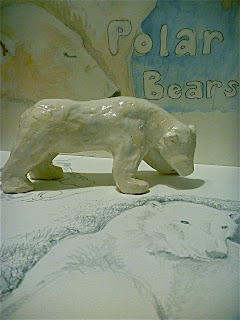
In order to sculpt people or animals an artist must become familiar with the anatomy of their subject.  For this next project each student will select an animal and then familiarize themselves with its structure through a series of drawings.  Once I feel that they have a firm grasp on the structural anatomy of their subject they will begin a sculpture of that animal out of clay which they will be expected to complete and glaze.

Monday, April 9, 2012

Earth Day Projects


This week students will be finishing up the projects started before spring break based on themes of the earth, the environment and nature.  These projects are due no later than Friday,  April 13th at 3:00 PM.  A completed  entry form must accompany the students' projects.

Monday, March 5, 2012

Mobiles


Alexander Calder; painter, sculptor, engineer, illustrator and the inventor of the mobile, is by many considered the most innovative artist of the twentieth century.....and..we get to go see his work at the Nasher Museum this week! The students will make a mobile of their own using paper mache, wire and string. They have already started designing them but the making will take a couple weeks. In addition to learning about actual physical balance, we will discuss and work with the concept of color balance.